ISO Standards in Dubai: What You Need to Know
Wiki Article
ISO Certification To Be Used In Abu Dhabi: A Practical Guide For Local Businesses
The business environment in Abu Dhafra has special pressures that are unique to ISO certification. Its structure is heavily influenced by the region's high concentration of government entities, big industrial operators, and strict conditions for tendering. Local businesses who are navigating ISO new certifications for the initial time understanding the practical realities specific to Abu Dhabi makes the process considerably smaller daunting.Government and Semi-Government tenders set the pace
The majority of Abu Dhabi's economy comes from companies that are linked to the government and major industrial companies, many of which have formalised ISO certification as a prequalification requirement for suppliers and contractors. This means the decision to get certification mostly driven less from internal ambition and more influenced by how practical contracts a company wants stay eligible for.
In the Energy and Industrial sectors, there are Particular Expectations
Abu Dhabi's industries and energy sectors have extremely strict standards in terms of environmental and safety, given the scale and risk profile of work in these sectors. Businesses that participate in this system (sometimes indirectly) encounter that certification requirements from the clients they directly deal with are higher than the minimum standards, indicating the sector's own internal policy on risk-management.
Finding a Standard that matches the actual operations you are running
A common error is to pursue a certification merely because a competitor has it not first mapping out the certification that truly matches the business's exposure profile and client expectations. Logistics companies' priorities are distinct from those of an organization that manages facilities, and beginning with a clear review of what clients and tenders actually need can help save unnecessary effort later.
It's the Gap Assessment Stage is to be taken seriously
Prior to formal implementation conducting a gap assessment with respect to the applicable standard shows how well existing practice adheres to the standard and where significant work is required. Doing this too quickly or skipping it results in a more lengthy stage of implementation that costs more in the future, as any gaps that could have been identified earlier and then become apparent during the audit itself.
Documentation Requirements are Much More Manageable than They Make It Sound
Many people who are first time applicants think that ISO documentation requirements will be overwhelming, but current management system standards are less prescriptive in their approach to paperwork as older versions were, insisting instead on showing that processes are actually being followed and not just documented. An approach that is practical to document that is based on what the business will want to document in the first place, is likely to create systems that are actually used instead of one that's exclusively for audit purposes.
The options for local support have grown By a significant amount
Abu Dhabi now has a large pool of consultants and certification bodies with local sector expertise than it did five years ago, reducing the need to rely entirely for international companies without local location. This local expansion has generally made the process faster and more adaptable to the particular needs of working in the region.
Maintaining certification is a commitment to continue.
Certification isn't a single achievement but an ongoing commitment involving regular audits of surveillance, usually annually, which ensures that the management system remains properly maintained. Companies who view the initial certificate as a way to finish instead of the start point frequently struggle with later audits. On the other hand, companies who translate the requirements of the standard into their everyday practices will Recertification is much easier.
Free Zone Businesses are subject to Particular Considerations
Companies operating out of Abu Dhabi's free zones often assume that certification requirements differ from those that apply to mainland businesses, but the general standards of international practice remain in the same way regardless of where they are located. What does vary is the particular requirements for tenders and clients in each tenant community, which is necessary to address directly with authorities of the free zone or prospective clients, instead of thinking the same answer is universally applicable.
The Realistic Budgeting Process
Initial applicants may budget only to cover the cost of external audit but neglect to include the internal investment in time, consulting fees, and adjustments to the operation that are required to fill in gap that was discovered during assessment. A proper budget will take into account all the steps from initial assessment to certificate issue, not just the invoice for the final audit, so that you don't get a surprise in the middle of the project.
Timing Certification for Business Cycles
Companies with clear seasonal peak prevalent in the construction industry and events-related sectors, often can schedule the more demanding implementation and audit stages at times when there is less noise, rather than attempting to schedule certification projects in tandem with high operational demands. Abu Dhabi's certification agencies are typically flexible with their timeframes and scheduling, and elevating timing preferences earlier in the process is likely to result in a more pleasant experience for everyone involved.
Learning From Businesses That Have Recently Been Through It
Talking directly with other Abu Dhabi businesses in a similar sector that have had certification can provide facts that consultants or certification bodies will freely divulge, from realistic timelines to aspects of the audit tend to catch prospective applicants off to their feet. This kind of knowledge gained from peer-to-peer relationships is genuinely valuable and worth researching before committing to a particular company or timeframe.
Working With Government Liaison Requirements
Companies seeking certification so that they can be considered for government tenders that are being offered in Abu Dhabi should confirm exactly the scope of certification and version a particular tender demands and, as the requirements often refer to specific editions or additional local requirements that go beyond the base international standard. Confirming this detail directly with the authority that is tendering before getting started on the certification process minimizes the chance of completing certification against the wrong scope entirely.
for Abu Dhabi businesses approaching certification for the first time, the success usually depends on selecting the best standard to match operational reality, while taking the stages of preparation seriously, and considering certification as an ongoing operating discipline, not just an obligation to complete once and forget. Abu Dhabi businesses that approach certification with this degree of preparation rather than thinking of it as a last-minute solicitation to rush through, are always left with a better, more effectively-designed management system at the end. The entire process should not be tackled on its own. the growing number of highly skilled local consultants and certification bodies means genuinely knowledgeable support is more accessible now than it has been before. Utilizing that expanding local knowledge base makes the whole journey much more manageable than it used to be. Follow the most popular ISO 20000 Certification for more advice.

ISO 14001 Certification: Why Environmental Management Is Important For Uae Companies
Environmental considerations have moved beyond being the status of an afterthought to a major business issue across the UAE, driven partly by government sustainability initiatives and partly because of the rising regulatory and client expectations. ISO 14001, the international standard for environmental management systems is a natural solution for companies who want to display genuine and structured environmental responsibility rather than just good desires alone.What ISO 14001 Actually Requires
The standard calls on businesses to assess the environmental effects of their business, comprehend their impact on their environment, and implement strategies that can manage and reduce negative impacts in the course of time. It could be anything in the area of managing emissions and waste in a production environment to lessening the use of energy and paper use in an office-based service business, because the standard is applicable proportionally to any environmental impact a business's footprint is.
Alignment With UAE National Sustainability Goals
The United Arab Emirates' broader commitments regarding sustainability and net zero targets are generating real momentum around environmental management. ISO 14001 certification gives individual companies a way to demonstrate their compliance with those greater goals. This has become increasingly important for companies bidding on government and semi-government tenders, where environmental accreditation is increasingly an clear evaluation criterion.
Industries that matter the most
Manufacturing, construction, oil and gas, and logistics typically face the most direct environmental scrutiny because of the sheer size of their operations. However, service-oriented businesses are increasingly pursuing certification too, both for tender qualification and cost savings due to greater efficiency in resource use. Even companies that have a thin environmental footprint, often an organized approach can reveal surprising savings opportunities.
Legal Compliance Angle Legal Compliance Angle
The major component an important aspect of ISO 14001 involves identifying and verifying compliance with applicable environmental legislation and regulation requirements. These in the UAE situation, includes federal environmental law, as well as local regulations. Certified companies generally possess a better, more updated understanding of their legal obligations than those who aren't certified, decreasing the chance of accidental non-compliance, and consequent penalties.
Integrating With Other Management Systems
Many UAE companies who are working towards ISO 14001 already hold or are pursuing ISO 9001, and the two standards have some structural characteristics that an integrated control system covering both is usually more efficient over treating them separate projects. This integrated approach decreases duplicated the documentation and auditing process significantly for businesses that are managing multiple certifications.
What is the Certification Process Does
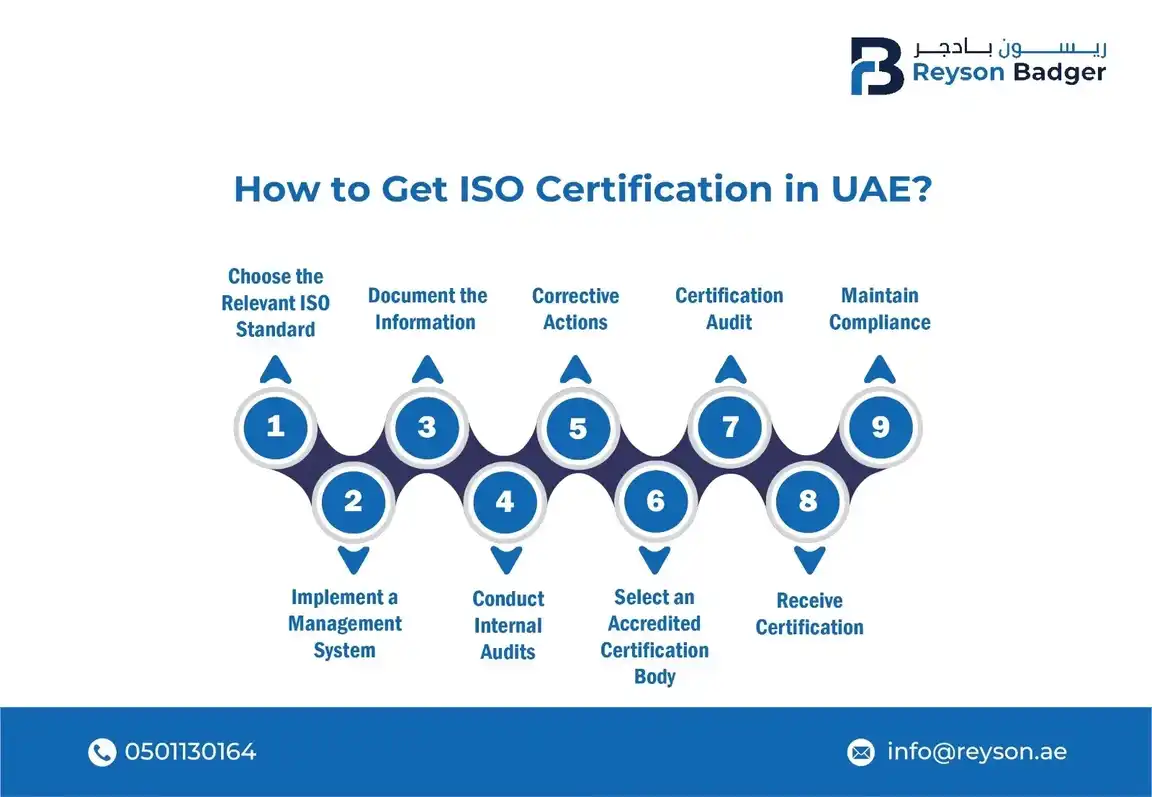
Similar to other management system standards certification follows a standardized route: an initial gap analysis, the introduction of necessary processes and documentation internally audited, and following that, an external two-stage audit completed by an accredited certification body. In-depth surveillance audits which are usually annually, ensure that the environmental management system is properly maintained rather than lapsing after the initial certificate is issued.
Truly Business Benefits That Go Beyond the Certificate
Beyond tender eligibility and regulatory clarity, those who adopt ISO 14001 properly often uncover real cost savings by implementing better resource and waste management. They also reap reputational benefits with more environmentally conscious clients and business partners. These advantages are a big part of the reason why eco-certification has gone beyond being merely a compliance-driven exercise for many UAE firms.
How to Measure What Really Matters
Implementing a well-designed ISO 14001 system focuses measurement efforts on the environmental issues that matter the most for an individual business and not tracking numbers solely based on how easy they are to track. Logistics companies may prioritize energy consumption and efficiency of the route while a manufacturing company could be more concerned with waste generation and water use in order to determine where each business's actual environmental impact is.
Engaging Suppliers and Contractors
Many UAE businesses realize that a substantial portion of their environmental footprint is attributed to contractors and suppliers in addition to their own operations. ISO 14001 encourages businesses to look at this supply chain impact instead of making environmental management purely an internal matter. This has prompted certain certified UAE organizations to ask their own key suppliers about ways to reduce their environmental impact, and resulting in an ensuing ripple effect in local supply chains.
Security Preparedness for Emergencies is Part of the Standard
ISO 14001 requires businesses to consider the possibility of environmental emergency situations related to their activities, such as chemical spills or equipment malfunctions that could have environmental consequences, and have genuine strategies for response instead of handling such emergencies in a reactive manner. This element of preparation often uncovers problems that the business hasn't previously taken into account, specifically around staff training for emergency scenarios.
A Standard that Rewards Genuine Commitment
Ultimately, ISO 14001 rewards businesses that consider environmental management an ongoing, operational necessity rather than a documentation exercise carried out once and discarded. UAE companies that embed the principles of the standard into daily decision-making instead of placing it within a separate compliance function, generally see the most effective environmental and social benefits over time.
The Water Management Area is of particular importance in the UAE In the context of
Because of the desert climate in the UAE and dependence on desalinated freshwater as well as its water management, water usage is frequently a focus of an ISO 14001 system compared with regions where water scarcity is less important. Businesses that build water efficiency into their environmental management process from the beginning tend to see this as one of the most relevant aspects of certification within the local situation.
For UAE companies with ISO 14001, the certification offers both a reaction to actual pressure from the market and regulators and a structured opportunity to manage environmental impact more effectively, which influences regulators and clients as well as the UAE's own national sustainability objectives. As environmental demands across the UAE continue to increase those who build an effective sustainable management of their environment now, instead of waiting until it becomes an unavoidable requirement, are likely to stand out in the future. The process should not be a burden for small businesses given that the norm scales in proportion, and even the smallest real environmental changes implemented consistently tend to satisfy auditors in excess of a grandiose plan which is not followed through. Consistency, and not just ambition alone, is ultimately what auditors as well as genuine environmental results both reward. Small, consistent changes tend to perform better than ambitious plans that quickly stall after only a few months. Read the best ISO Consultants Dubai for blog recommendations.